ON DEVICE
No link needed.
Threshold checks, safety interlocks, local filtering, immediate alerts.
Stacx24 engineers edge intelligence, telemetry and connected software systems that transform physical events into useful operational information.
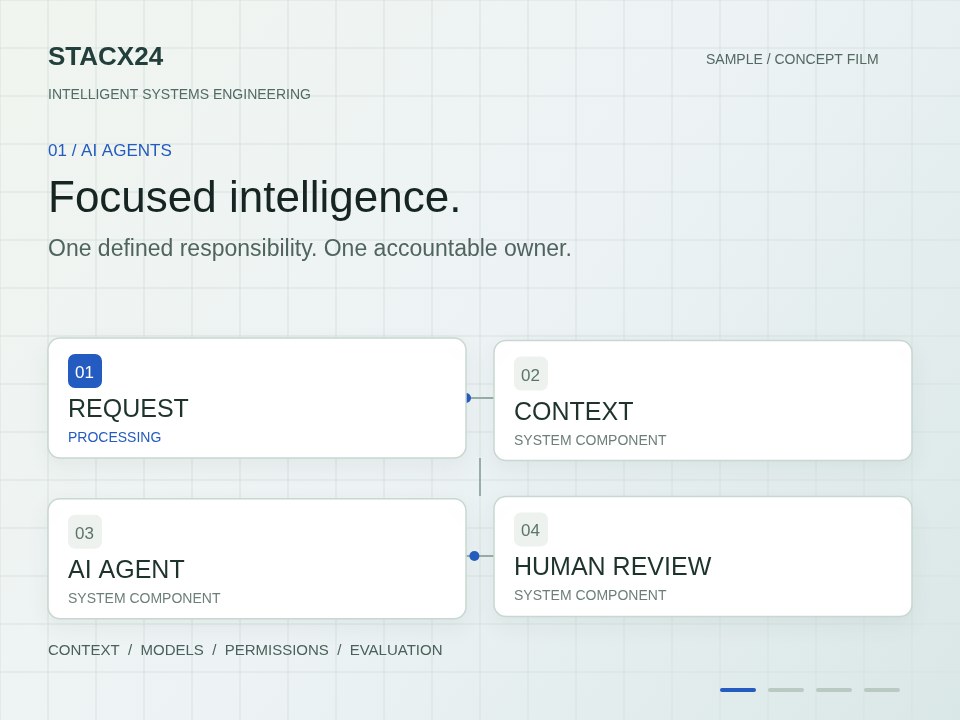
Twenty-second silent sample with on-screen text: focused AI agents; connected applications and workflow automation; sensors, edge processing and telemetry; human approval and measurable outcomes.
Video playback is unavailable. Download the sample film.
Not every reading needs to travel to the cloud, and not every decision can wait for it. We place processing on the device, at the site gateway or in the cloud according to what the operation needs: how fast the response must be, how much the link can carry, what happens when it drops, and what should never leave the building.
No link needed.
Threshold checks, safety interlocks, local filtering, immediate alerts.
Site-wide context.
Aggregation, local models, buffering through outages, privacy-preserving processing of camera data.
Fleet-wide intelligence.
Trends across sites, model training, dashboards, integration with operational applications.
Act on site without a round trip.
Reduce response delays by processing close to the source.
Send summaries and exceptions, not raw streams.
Keep operating and buffer until the uplink returns.
Discard noise at the source so what arrives means something.
The person on site hears first.
Process camera and personal data locally; transmit only derived events.
A sensor reading on its own is a number. Classified into the right kind of signal and placed next to the records of the operation, it becomes something a rule, a model or a person can act on. We design the telemetry model before the first device is installed.
pump_02.state = RUNNING · routes to DASHBOARD
Listed by layer, in the order a signal travels: IoT and edge systems engineering from sensor to edge AI to the cloud. We select, integrate and program these components; we do not manufacture them.
We engineer the right combination.
A research document starts the work. The original stays available throughout.
Existing records, source details and the approved label list give the document context.
Software checks for duplicates and missing information before any AI suggestion.
AI proposes a label from the approved list. It cannot publish the label itself.
The researcher reads the supporting passage and approves or corrects the suggestion.
Only the approved label enters the record, alongside its source.
The system records the suggestion, the review and the saved result so the team can inspect them.
The team reviews corrections and agrees changes to the guidance before the next document.
An incoming request starts a handoff between the tools your team already uses.
The system brings together the request, existing records and its responsible owner.
Defined rules check the request and pass its details between connected applications.
This example needs no AI decision. Defined rules identify an exception and send it to its owner.
A named person supplies the missing detail and confirms that the work can continue.
The confirmed information reaches the next application and the work continues.
The system records completion and exceptions so the team can see what happened.
The team reviews repeated exceptions and approves rule changes for future requests.
A new field reading starts the cycle, connecting conditions on the ground to the system.
Field history and recent conditions help the team interpret the new reading.
Local edge checks validate readings before relevant information reaches the monitoring application.
The system uses the checked information to propose a response within its defined scope.
The agronomist checks the proposal and approves or adjusts it before it reaches the operator.
The approved proposal reaches the operator with the instructions they need.
New readings and operator reports help the team understand what happened next.
The agronomist reviews the observations and agrees guidance for the next cycle.
Something happens in the operation.
Records, history and state are attached.
Rules, software and integrations do the deterministic work.
One bounded AI component, where judgement can be modelled.
A named person decides where it matters.
Something changes in the world.
Telemetry and monitoring record what happened.
The loop feeds back into the next event.
Physical systems fail in physical ways: power, weather, a cable, a moved router. The system is engineered to keep operating, tell someone, and recover without a site visit.
Local logic keeps running. Alerts raise on site first.
Readings are stored at the edge and forwarded in order when the uplink returns.
Backoff, deduplication and idempotent delivery. Nothing is sent twice or lost.
Heartbeat, temperature, storage and firmware state reported per device.
Watchdogs, safe restarts and remote recovery without a site visit.
Per-device identity and credentials. Unknown devices are refused.
TLS between device, edge and cloud. Keys rotate.
Fleet and site state observable in one place, with an owner for each alert.
Secondary uplinks and redundant gateways where the operation justifies them.
Field sensors and edge inference feeding irrigation and crop-condition decisions, buffered through intermittent connectivity, with an agronomist approving changes before they reach the field.
We use three necessary cookies and, only with your consent, one analytics cookie. No advertising, no tracking. Cookie policy.